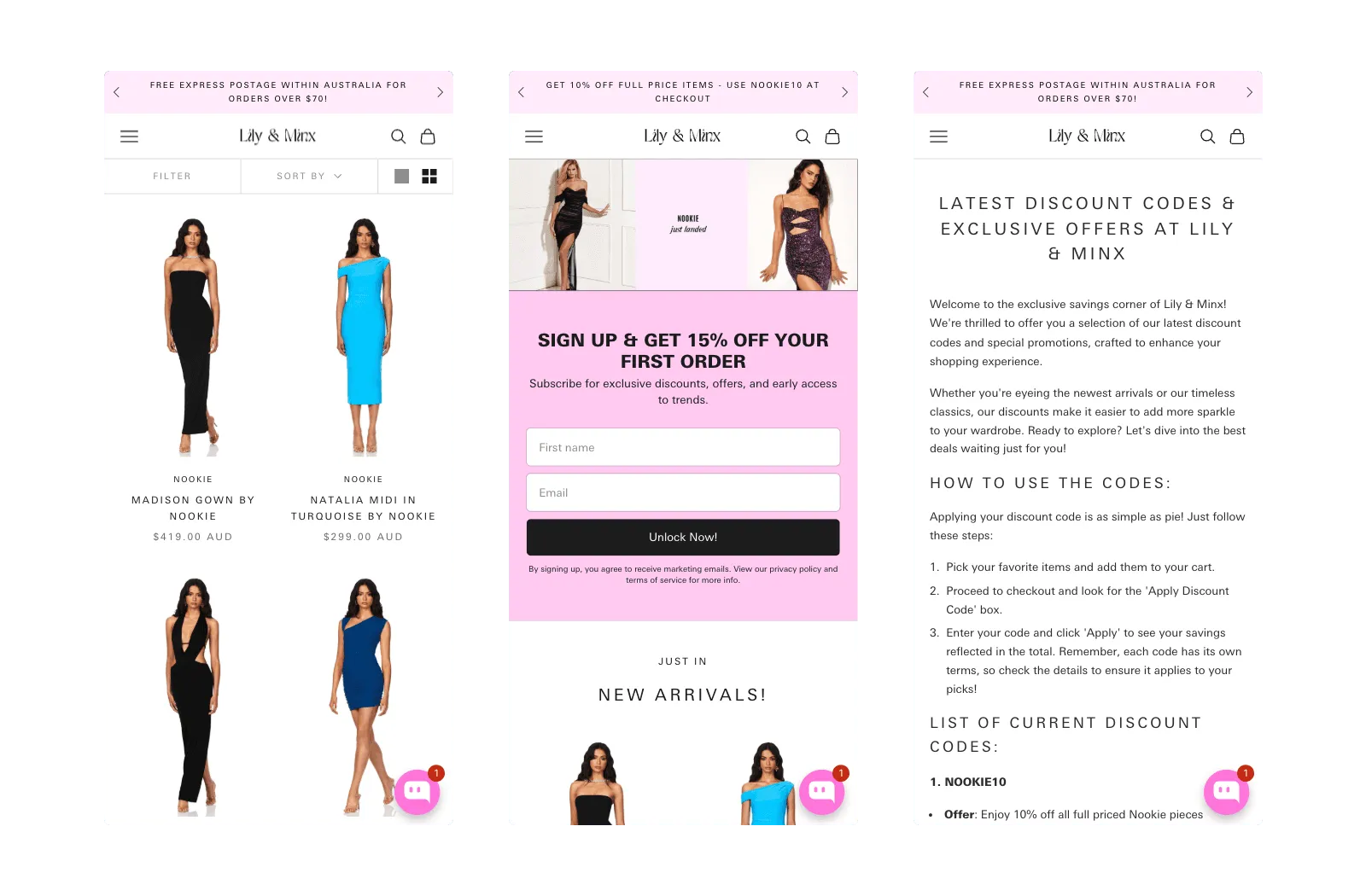
Case study Fashion retail, Shopify
Shopify catalogue restructure and mobile-first rebuild
Years of organic growth had left a catalogue customers had to dig through and staff had to fight. Most traffic had moved to phones ahead of the storefront, so shoppers met that friction on the device most of them used.
- Client
- Lily and Minx
- My role
- Led the store's redesign and rebuild, from catalogue structure to email automation
- When
- 2023
- Disciplines
- Catalogue architecture, Mobile-first UX, Shopify implementation, Email and retention
- Live site
- lilyandminx.com.au(external site)
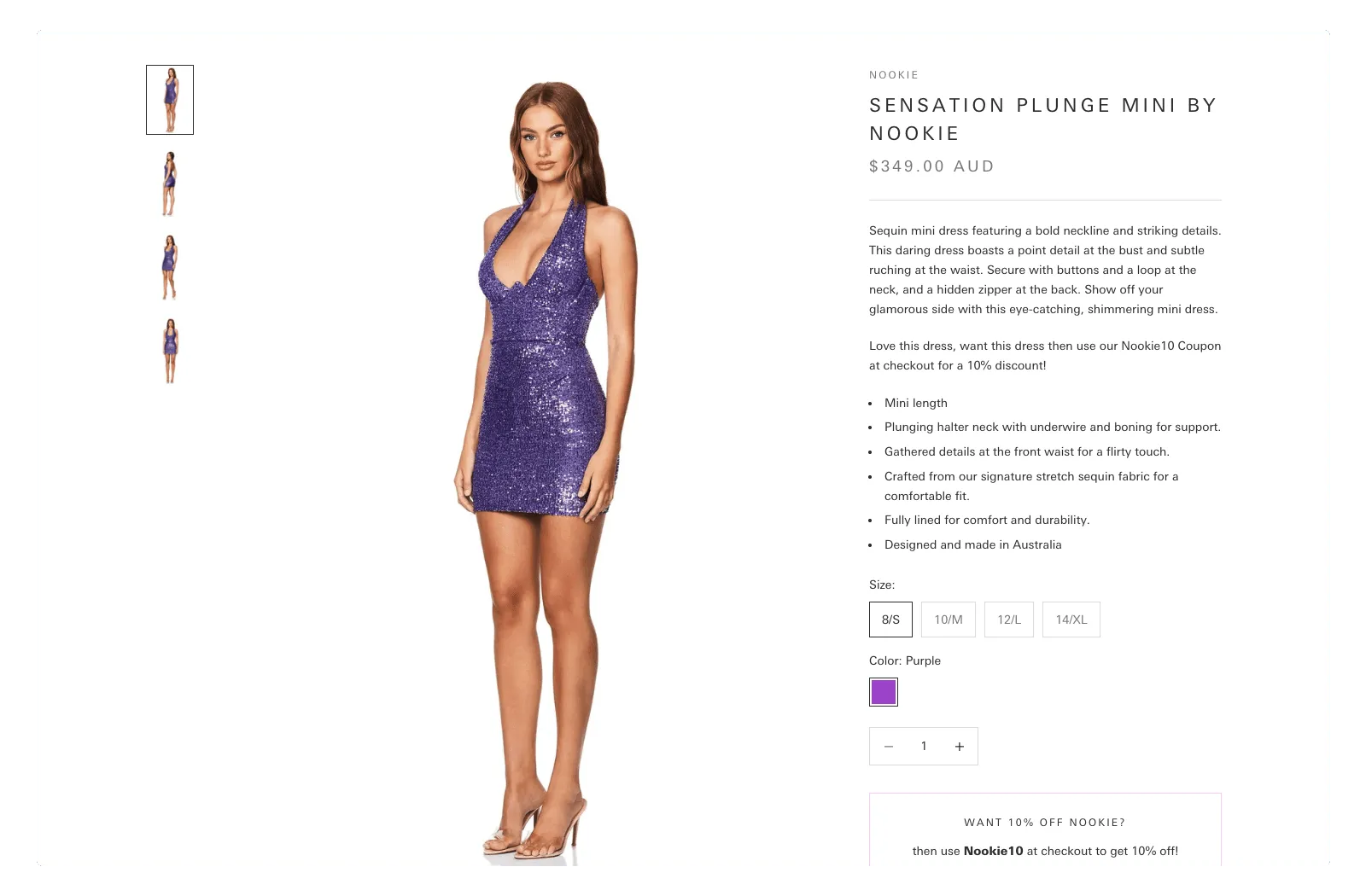
Context
Lily and Minx is a long-standing fashion label with a loyal customer base and a strong retail presence. Its Shopify store had grown organically for years while customer expectations and shopping habits moved to mobile. The brief was a full overhaul of the store's design and functionality.
Constraints
- Shopper navigation and back-office management had to get simpler together, though they usually pull apart.
- Most traffic was already on phones, so the storefront had to work mobile-first.
- The team had to be able to maintain the catalogue without me once the work was done.
- The rebuild had to carry the brand's style across devices.
- Copy and policy pages had to meet current standards.
Diagnosis
Most of the problem wasn’t visual. A store that has traded online for years builds its structure by addition, and the catalogue showed it:
- Collections that made sense once. They stayed in place after the reason for them had gone.
- Products filed for the moment. Items sat wherever someone could find them at the time, which didn’t help the next person looking, customer or staff.
- Navigation grown by addition. Menu entries had been added over time rather than planned as a whole.
- A storefront behind its traffic. Most visitors were on phones well before the store was set up for them.
The commercial cost showed up on both sides. Customers had to dig through the catalogue to reach products, which is friction placed directly between intent and a sale. Staff had to fight the same structure to keep the store current, so every update took more effort than it should have.
Two gaps sat outside the catalogue. The brand had no email programme, so it had no retention channel of its own and had to rent attention back whenever it wanted customers to return. Copy and policy pages had also fallen behind current standards.
That set the priority. A new look on top of the old structure would have left the hardest part of the problem in place.
Approach
Make the shopper’s view and the back office agree
The main piece of work was the catalogue. Customer-facing navigation and back-office management usually pull against each other: the grouping that helps someone browsing is not always the one that helps the person maintaining it. I treated getting the two to agree as the core of the job, since fixing one side alone would leave the friction on the other.
Let the theme present the structure
The storefront moved to a premium Shopify theme, configured mobile-first because that was where most of the traffic was. The theme’s job was to present the new structure well on a phone, not to stand in for it.
Speed underneath the theme
The domain moved to Cloudflare for speed and protection. That work sits below the theme rather than depending on it.
A channel the brand owns
Email was set up to grow the subscriber list and to bring customers back through a channel the brand controlled.
Implementation
Catalogue
I restructured the full inventory, reorganising how products were grouped and surfaced. The store structure was reconfigured alongside it, aimed at quicker discovery for customers and a more efficient backend for staff.
Storefront
I led the redesign and redevelopment of the store on a new premium Shopify theme, deployed and configured with a mobile-first approach so it held up across devices. Theme work used Liquid, HTML, CSS with SASS, and JavaScript.
I also migrated the domain to Cloudflare.
I built the email programme from scratch, covering:
- copywriting
- visuals
- policy updates
- the backend automation that runs it
Copy and policy pages
I wrote new copy for the store and updated the policy pages in line with current standards. LLMs were part of the process for content ideation and copy refinement.
Outcome
Structural outcome: what changed in how the site works
The store loads significantly faster and its conversion paths are clearer. The catalogue is organised for customers finding products and for staff managing them, and the team can maintain it without needing me. The brand also has an email programme of its own for list growth and retention.
Tools